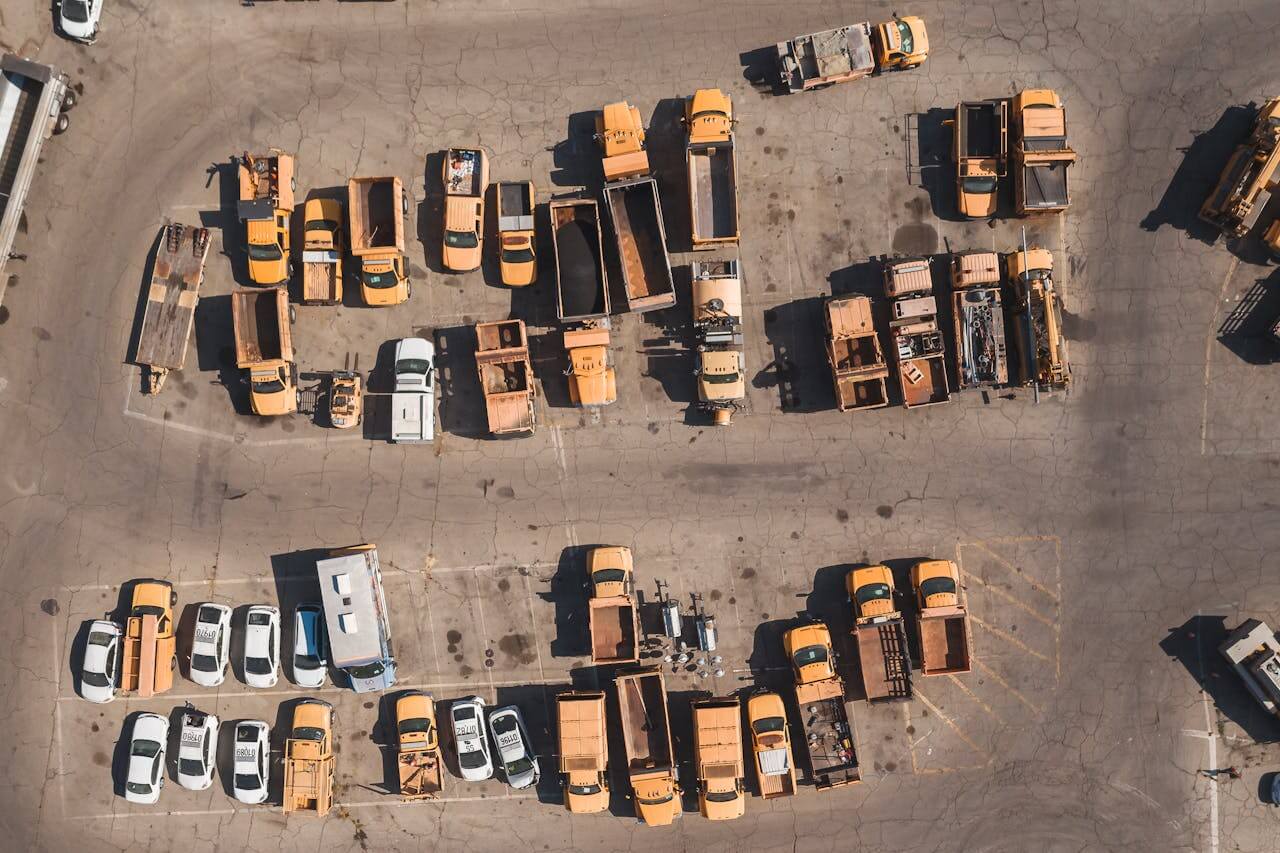
Dedicated truck parking facilities are essential for logistics hubs, distribution centers, and industrial areas. At Allon Consulting, we construct heavy‑duty parking areas designed to withstand constant heavy loads, provide safe maneuvering, and meet operational requirements. Our projects include paving, drainage, lighting, security, and amenities, ensuring a functional and durable facility.
1. Site Planning and Layout
We work with clients to optimize space:
- Parking Geometry
Stall dimensions typically 3.5 m × 16 m for semis; wider for oversize vehicles. Aisle widths 18‑25 m for turning radii. - Maneuvering Areas
Accommodation of 45‑ to 90‑degree backing; we use turning templates and AutoTURN simulations to ensure safe movement. - Traffic Flow
One‑way or two‑way lanes; entry and exit configurations that minimize congestion. - Separation from Cars
Physical barriers or designated zones to prevent conflicts.
2. Pavement Design for Heavy Loads
Truck parking requires robust pavement:
- Subgrade Preparation
Compaction to ≥ 95% modified Proctor; undercutting of soft spots; geotextile separation. - Base and Subbase
Granular layers of crushed stone, typically 300‑500 mm total thickness, with high bearing capacity. - Pavement Type
- Asphalt – with heavy‑duty mix (PG 76‑22 or similar), often 150‑200 mm over base.
- Concrete – 200‑300 mm thick, reinforced or jointed plain, with load transfer devices. Concrete offers superior durability for static loads and fuel spills.
- Design Life
We use mechanistic‑empirical design (e.g., AASHTOWare) to achieve 20‑30 years of service.
3. Drainage and Stormwater Management
Proper drainage prevents pavement deterioration and manages runoff:
- Surface Grading
Slopes of 1‑2% toward inlets; pavement with proper crowns to avoid ponding. - Catch Basins and Storm Sewers
Spacing based on gutter flow; heavy‑duty grates to withstand truck loads. - Oil/Water Separators
Required where runoff may contain fuel, oil, or grease. We design concrete separators with coalescing media. - Detention/Retention
Stormwater storage to meet regulatory requirements.
4. Lighting and Electrical
Safety and security require well‑lit areas:
- Lighting Levels
Illumination of 10‑20 lux for maneuvering; 5‑10 lux for parking aisles. We use photometric analysis to ensure uniformity. - Pole Types
Steel or aluminum poles with LED fixtures; heights 12‑18 m to cover large areas. - Energy Efficiency
Solar‑powered LED systems where grid connection is limited; dimming controls during low‑activity hours. - Security Cameras
CCTV placement with night vision; integration with security office.
5. Security and Access Control
We incorporate features to protect assets:
- Perimeter Fencing
Chain‑link with barbed wire or anti‑climb mesh; sliding or swing gates. - Access Control
Gate operators with card readers, RFID, or license plate recognition; intercom systems. - Security Booth
Enclosed structure with HVAC, restroom, and monitoring equipment. - Surveillance
Pole‑mounted cameras with remote monitoring.
6. Amenities and Support Facilities
To serve drivers, we include:
- Washrooms and Showers
Pre‑fabricated or permanent buildings with plumbing. - Break Rooms
Vending machines, seating, and Wi‑Fi. - Fueling Stations
Diesel pumps with above‑ground or below‑ground tanks; spill containment. - Maintenance Facilities
Small shops for tire repair, minor service. - Waste Receptacles
Roll‑off bins for trash and recycling.
7. Construction Methods
- Earthworks
Cut/fill to achieve grades; stabilization of subgrade. - Paving
Asphalt paving with heavy‑duty rollers; concrete paving with slip‑form equipment. - Utility Installation
Underground electrical, water, sewer, and fiber optic conduits. - Building Construction
Pre‑engineered metal buildings or modular units for amenities.
8. Quality Control and Testing
- Compaction Testing
Nuclear gauge for subgrade and base. - Pavement Testing
Thickness cores, smoothness, and density. - Concrete Strength
Cylinder tests; air content. - Lighting Photometrics
Post‑installation verification.
9. Typical Projects
- Logistics Hub Truck Parking
Constructed 15,000 m² of concrete pavement with 150 truck stalls, LED lighting, security fencing, and a driver’s building with washrooms. Included oil/water separators and detention pond. - Industrial Park Expansion
Added 50 heavy‑duty asphalt stalls with permeable pavers in overflow areas; incorporated EV charging for refrigerated trailers. - Rest Area with Truck Parking
Built 20‑stall facility with fueling, convenience store, and shower facilities. Used solar‑powered lighting and water‑efficient fixtures.
Our truck parking construction services deliver safe, durable, and functional facilities that meet the demanding needs of the transportation industry.